What is #57 Gravel?
#57 gravel is a crushed stone aggregate commonly used in construction, landscaping, and drainage systems. It consists of angular stones typically ranging from ½ inch to 1 inch (about 12–25 mm). The name “#57” refers to the sieve size used during processing. Its shape allows water to drain while providing a stable surface.
Made from limestone, granite, or trap rock, #57 gravel supports heavy loads yet remains loose enough for natural water movement. It’s ideal for French drains, driveways, patios, and more.
#57 Gravel Size and Gradation
The typical #57 gravel size ranges from ½ inch to 1 inch in diameter. This aggregate size is produced by screening crushed stone through standardized sieves. When people ask “what size is #57 stone” or “what size is 57 gravel,” they are usually referring to this ½″–1″ range.
Because of its uniform shape and lack of fine particles, #57 stone drains well while still locking together for structural support. It is commonly used as drainage rock, driveway gravel, and base material under slabs.
- Nominal size: ½″ to 1″
- Aggregate classification: No. 57 stone
- Common materials: Limestone, granite, trap rock
- Best for: Drainage, driveways, French drains, concrete base
How is #57 Gravel Different from Other Gravels?
#57 gravel differs in size, shape, compaction, and use:
| Gravel Type | Shape | Best Use |
|---|---|---|
| #57 stone | Angular, ½″–1″, almost no dust | Drainage, French drains, open driveway stone |
| Pea Gravel | Rounded | Landscaping, playgrounds, decorative areas |
| Crusher Run | Angular + fines | Driveways, compacted base layers |
| #67 Gravel | Angular | Slabs, fine drainage |
| #3 Gravel | Angular | Base fill, erosion control |
| Recycled Gravel | Mixed | Budget fill, non-structural use |
Weight of #57 Stone per Cubic Yard
Clean #57 is mostly air between the stones, so a cubic yard is lighter than a compacted base such as 304 or class 5. These bands are the ranges quarry and landscape-supplier density sheets usually print for loose, clean crushed stone. Moisture, rock type, and whether the scale ticket is for a heaped or struck yard all move the number. There is no single official weight. If the supplier prints a density, use that in the calculator.
| Material | Tonnes per m³ | US tons per yd³ | When you see it |
|---|---|---|---|
| Limestone #57, loose | 1.50–1.65 | 1.25–1.40 | Typical 57 limestone. The calculator default, 1,600 kg/m³, is 1.60 tonnes/m³ and 1.35 tons/yd³. |
| Granite #57, loose | 1.60–1.75 | 1.35–1.47 | Heavier clean stone, still open-graded. |
| Trap rock #57, loose | 1.70–1.80 | 1.43–1.52 | High end of the usual 1.35–1.5 ton range. |
| Damp load | up to about 1.85 | up to about 1.55 | Rain adds weight. #57 still does not bind into a hard surface. |
One US ton is 2,000 lb. One tonne is 1,000 kg. The “t” menu on each calculator is metric tonnes (kilograms ÷ 1,000). The tons line under the result is US short tons from the same weight.
What Are the Applications of #57 Gravel?
#57 gravel fits many projects thanks to its drainage and structural properties:
| Application | Why It’s Used | Typical Depth |
|---|---|---|
| Driveway Base | Interlocks for support, drains water | 4″–6″ (10–15 cm) |
| French Drain / Trench | Prevents water pooling, supports pipe systems | 6″–12″ (15–30 cm) |
| Concrete Slab Sub-base | Reduces cracking, provides stable foundation | 4″–8″ (10–20 cm) |
| Retaining Wall Backfill | Relieves hydrostatic pressure with drainage | Varies |
| Landscaping Beds | Aesthetic ground cover, inhibits weeds | 2″–3″ (5–7.5 cm) |
| RV or Trailer Pads | Withstands repeated tire loads | 4″–6″ (10–15 cm) |
| Under Decks & Sheds | Improves drainage, prevents mud | 3″–4″ (7.5–10 cm) |
| Erosion Control | Heavier rock resists movement on slopes | 6″ (15+ cm) |
Where #57 Gravel Should Not Be Used
- Highly compacted surfaces needing a smooth finish
- Children’s play areas or barefoot zones
- Steep slopes without proper edging
- Tightly sealed patios or walkways
- Small gaps or narrow crevices (use custom triangle calculator instead)
Tips to Use #57 Gravel
- Install landscape fabric underneath to prevent soil intrusion
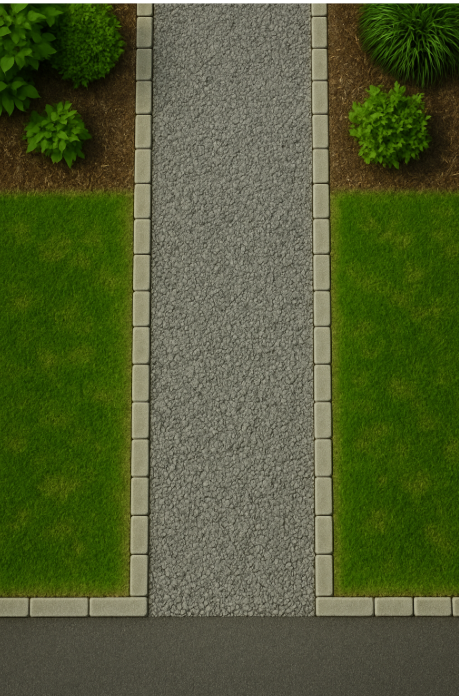
- Edge paths or driveways to contain gravel
- Compact in layers for stability
- Mix with fines for a smoother surface
- Ensure proper slope for drainage
#57 Coverage and Dump-Truck Loads
Cubic yards = length (ft) × width (ft) × depth (in) ÷ 324. Tons below use 1.35 tons per cubic yard, the same 1,600 kg/m³ default as the calculators. Multiply by about 1.11 if your stone is closer to 1.5 tons per yard. A tandem dump truck is counted at 14 tons, a common middle of the 12–16 ton range.
| Area | Depth | Cubic yards | Cubic meters | Tons | 14-ton trucks |
|---|---|---|---|---|---|
| 10×10 ft pad | 2 in | 0.62 | 0.47 | 0.83 | part of 1 |
| 10×10 ft pad | 4 in | 1.23 | 0.94 | 1.66 | part of 1 |
| 12×20 ft pad | 4 in | 2.96 | 2.27 | 4.00 | part of 1 |
| 12×40 ft driveway | 4 in | 5.93 | 4.53 | 7.99 | 1 |
| 12×40 ft driveway | 6 in | 8.89 | 6.80 | 11.99 | 1 |
| 20×50 ft drive | 6 in | 18.52 | 14.16 | 24.97 | 2 |
At this density one ton covers about 120 square feet at 2 inches, 80 square feet at 3 inches, and 60 square feet at 4 inches. A small landscape truck (about 5–7 tons) is enough for the pads. The 20×50 ft drive needs two tandems.
Worked Example: 12×40 ft Driveway
A two-car driveway 12 feet wide and 40 feet long, covered 4 inches deep with #57:
- Cubic yards = 12 × 40 × 4 ÷ 324 = 5.93 yd³
- Cubic meters = 5.93 × 0.765 = 4.53 m³
- US tons at 1,600 kg/m³ = 7.99 tons (about 8.9 tons if the stone is 1.5 tons/yd³)
- Tonnes at 1.60 tonnes/m³ = 7.25 tonnes
- Retail bags of 0.5 ft³ = 160 ft³ ÷ 0.5 = 320 bags, so this is a bulk order, not a bag job
One 14-ton tandem carries it with room to spare. Add roughly 10 percent if the edges are soft or you are filling ruts. The calculators do not add that extra. Enter 12 ft × 40 ft × 4 in on the rectangular calculator and you should see 5.93 cubic yards, 4.53 cubic meters, and 7.99 tons at the default density.
#57 Stone Material Guide
Size. No. 57 is crushed stone from about 1/2 inch to 1 inch. Most pieces are near 3/4 inch, but the gradation also allows some 1/2 inch chips and very little material finer than a No. 4 sieve. That open mix is why people compare it with 3/4 gravel and why it is the wrong product when the job needs dust to lock the surface.
What it is made of. Quarries crush whatever competent rock they have: limestone, dolomite, granite, or trap rock. 57 limestone is the same size made from limestone. It is the usual #57 in much of the Midwest and South, and it tends to sit at the light end of the weight range. The rock type changes color and weight. It does not change the drainage, because the voids come from the missing fines.
Best uses. French drains and footing drains, the open layer under a slab, pipe bedding, retaining-wall backfill, and a loose driveway or parking surface where you want water to disappear. Four to six inches is a common driveway depth for cars. Six to twelve inches is common in a drain trench.
Do not use it as a compacted driveway base, under pavers that need a tight bedding, on a barefoot path, or in a play area. It will not pack into a hard crust. For that job use 304 gravel, crusher run, or class 5. Pea gravel is the comfortable walking surface. #8 (about 3/8 inch) is the smaller clean neighbor. #4 is the larger drain rock, often 3/4 inch to 1-1/2 inches.
| Grade | Size | Packs? | Choose it when |
|---|---|---|---|
| #57 / 57 limestone | ½″–1″, clean | No | Drains and stays loose |
| Clean 3/4 | Around ¾″, clean | No | The quarry’s name for a similar clean stone |
| #67 | ¾″ down to about 3/16″ | Some | You want a bit more lock without full dust |
| 304, crusher run, class 5 | About 1″ or 1½″ down to dust | Yes | The layer has to become a hard base |
#57 Stone Questions
How much does a yard of 57 stone weigh?
About 1.35 to 1.5 US tons, or 2,700 to 3,000 pounds. Limestone #57 is usually near the low end. Granite, trap rock, or a wet load sits closer to 1.5 tons. The same range is about 1.6 to 1.8 tonnes per cubic meter. These calculators start at 1,600 kg per cubic meter, which is 1.35 tons per cubic yard.
How many tons of 57 stone are in a dump truck?
A small landscape truck often carries about 5 to 7 tons of #57. A tandem-axle dump truck is commonly about 12 to 16 tons, and a tri-axle can be about 16 to 22 tons. At 1.35 tons per cubic yard, a 14-ton tandem holds about 10 cubic yards. Ask the hauler for that truck’s legal payload, because rock type and axle limits change the load.
What is 57 limestone?
57 limestone is No. 57 stone crushed from limestone rather than granite or trap rock. The pieces are still about 1/2 inch to 1 inch, with almost no dust, so it drains the same way. It is usually a little lighter than granite #57, often around 1.35 to 1.45 tons per cubic yard. Many Midwest and Southern quarries sell #57 as limestone.
How much does one ton of #57 stone cover?
At 1.35 tons per cubic yard, one ton covers about 120 square feet at 2 inches deep, about 80 square feet at 3 inches, and about 60 square feet at 4 inches. A heavier 1.5-ton stone covers less ground per ton.
What size is #57 stone?
No. 57 is open-graded crushed stone, nominally 1/2 inch to 1 inch. Nearly all of it passes a 1 inch screen, a share passes 1/2 inch, and only a few percent passes a No. 4 screen. It is not a single-size 3/4 inch chip, and it does not include the stone dust found in 304, crusher run, or class 5.
Is #57 stone the same as 3/4 gravel?
They overlap, and clean 3/4 inch stone is often sold in place of #57 because both are mostly 1/2 to 1 inch and both drain. #57 follows a published gradation. A product labeled 3/4 minus includes dust and will compact, which #57 will not. Use the 3/4 gravel calculator when the ticket says 3/4 clean or 3/4 minus rather than No. 57.
How many cubic yards of #57 are in a ton?
About 0.67 to 0.74 cubic yards. At 1.35 tons per cubic yard, one ton is 0.74 cubic yards. At 1.5 tons per cubic yard, one ton is 0.67 cubic yards.
Can I use #57 stone in a French drain?
Yes. Water moves through the voids, and there is almost no dust to clog the pipe. Wrap the trench in fabric so soil does not wash in. Do not put 304, crusher run, or class 5 in that trench. Those grades are full of fines and are meant to pack, not to drain.